How many times have you made a choice based on a friend’s suggestion or just because you’re familiar with a particular brand name? While this works fine for the next Netflix series you watch, we can agree it’s not a suitable way of, say, deciding on how to create the website for your trillion-dollar startup idea.
So, you wouldn’t choose the no-code platforms for your website like that, right? …right?!
Yes, we get surprised. Every single time, we hear cybersecurity startup founders explain how they picked their no-code website platform during discovery calls. Months later, they’re stuck with slow load times, limited section controls, SEO constraints, plugin conflicts, or a website they can’t update without calling someone else – discovering us in the process (true story, and yes, that’s an em dash).
Websites now are much easier to build, customizable to the nth degree, and you can DIY it without any coding knowledge. Which also makes choosing from the umpteen website platforms a bit of an inconvenience if you’re not sure what your website requires.
Low-code and no-code platforms exist to remove most of that friction, but even they are not built on the same philosophy.
Some offer maximum design freedom.
Some prioritize simplicity and speed.
If you want world-class visual design for your website, there’s Webflow.
Then there’s WordPress, which gives you total control but demands technical ownership. And then, we have Strikingly, which is designed for founders who want to launch fast without wrestling with complexity.
Unlike e-commerce, lifestyle brands, consumer products, or local businesses, cybersecurity websites must communicate:
- technical authority
- buyer alignment
- trust and maturity
- strong SEO signals
- clear, jargon-free explanations
- differentiated positioning
Which means your platform choice directly affects how well you can execute all of the above. That’s why understanding which no-code website platforms are built for speed, which are built for scale, and which are built for simplicity is essential.
This blog aims to break down some of the major no-code platforms, pitting them against the real challenges cybersecurity founders face. The final goal: help you pick the no-code website platform that aligns with your business model, not just your design preference.
A Comparison of the Leading No-Code Platforms for Cybersecurity Websites
The adoption of low-code and no-code platforms for cybersecurity websites is not a recent trend. As early as 2018, 84% of enterprise organizations had already adopted low-code tools to reduce IT workloads and accelerate digital transformation initiatives.
Over the following years, these platforms moved from experimentation to standard practice. By 2024, it was projected that nearly four out of five businesses in the US would be using low-code tools for application development.
As of 2025, this shift has matured further, with 41% of organizations running active citizen development programs, where non-technical teams build internal applications and workflows without relying on engineering resources.
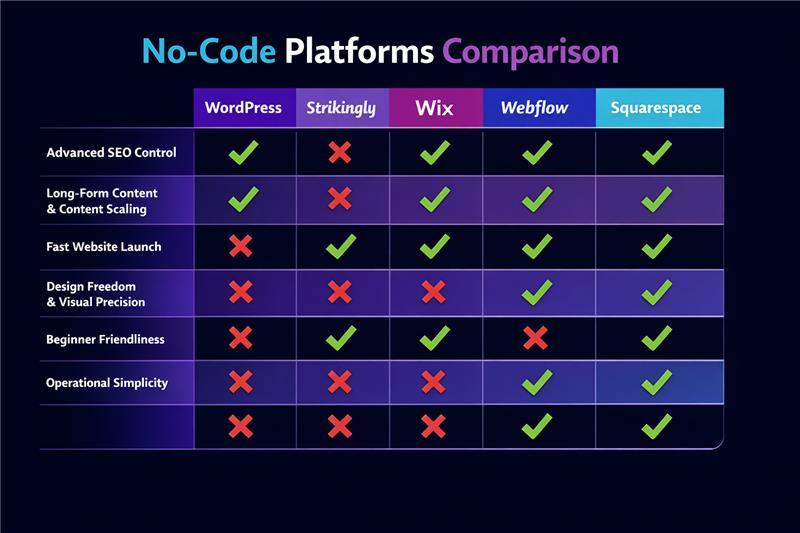
Here’s a practical, cybersecurity founder-focused view of the no-code platforms that we think matter most when building or rebuilding cybersecurity websites: WordPress, Webflow, Wix, Squarespace, and Strikingly.
Each of these platforms sits on a different point of the no-code platforms spectrum, and the right fit depends entirely on what stage your company is in and how fast your marketing needs to move.
What matters most is which no-code platforms can support the unique operational and content demands of your cybersecurity brand. Take a look at how each one handles structure, SEO, speed, and long-term growth.
WordPress: The Content Powerhouse
For cybersecurity startups planning to publish heavy, long-form content like threat insights, compliance updates, technical breakdowns, detailed service pages, and industry-specific frameworks, WordPress remains the most powerful foundation.
Self-hosted WordPress websites offer unmatched flexibility, complete SEO control, and an ecosystem of 50,000+ plugins that can extend the site in any direction you need.
But this power comes with operational responsibility.
WordPress isn’t like the pure no-code website platforms. To fully leverage it, you must manage hosting, updates, plugin conflicts, security patches, and performance tuning.
That means WordPress websites are best suited for cybersecurity startups in growth mode, i.e., teams that either have internal technical bandwidth or are ready to invest in managed hosting and support. But if simplicity and speed are your priority, it may not be the right fit.
Webflow: The Design-First Platform
Webflow sits at the opposite end of this spectrum: it’s the platform for cybersecurity brands that want a polished, custom, premium-looking website that feels engineered.
Its visual designer allows for a high level of precision, animation control, and layouts that can make your brand instantly feel more mature and enterprise-ready. For well-funded cybersecurity startups competing against established players, this branding edge matters.
But Webflow is not beginner-friendly. It has one of the steepest learning curves among no-code platforms and requires familiarity with CSS concepts to get the most value out of it.
It also introduces a multi-plan pricing model (site plans + workspace plans), which can be expensive for early-stage founders. Webflow is a great choice for cybersecurity founders who want high design control today and have no problem hiring ongoing design support tomorrow.
Wix: The All-in-One Hub
Wix offers a practical middle ground; it’s far easier than Webflow and far less technical than WordPress. With its drag-and-drop builder, AI-powered site generator, and large app marketplace, it gives small cybersecurity teams enough flexibility to build a strong digital presence without deep design or coding expertise.
However, Wix’s freedom can become a weakness. Drag-and-drop allows founders to design creatively, but it can also lead to inconsistent layouts if the website grows quickly or multiple people are editing.
Its SEO has improved significantly in recent years, but its structural flexibility still does not match that of WordPress. Wix is ideal for cybersecurity startups that want to look polished from the get-go and maintain control without technical overhead, i.e., as long as they don’t need advanced content architecture.
Squarespace: The Simplicity-First Platform
Squarespace offers a clean, modern, aesthetic-first experience that ensures your cybersecurity website always looks structured and visually coherent. Cybersecurity founders who prefer minimalist layouts and clear messaging often gravitate toward Squarespace because it reduces decision fatigue and keeps the brand sharply presented.
Its content tools are strong, particularly for blogging. But its ecosystem is intentionally limited. You cannot extend it deeply, and you cannot customize functionality the way you can on WordPress or even Wix.
Squarespace works best for early-stage cybersecurity consultancies, personal brands, or advisory firms that want a professional look without dealing with plugins, maintenance, or too many customization choices.
Strikingly: The Speed Runner
Strikingly website builder belongs to a very specific category: no-code website platforms designed for founders who need absolute speed and zero friction.
If you’re building your first cybersecurity site, validating a service idea, launching a temporary landing page for a webinar or workshop, or simply needing a professional presence while refining your positioning, the Strikingly website builder gets you online in minutes.
Effortless setup, extremely low learning curve, ability to switch templates without rebuilding, 24/7 support (even on the free plan), and a pricing model that rewards long-term usage.
Where Strikingly falls short, intentionally, is depth. Its SEO tools are basic. Its ecosystem and design flexibility are limited. But that’s not what it’s built for. Strikingly is designed to remove obstacles, especially for cybersecurity founders who are early in their journey and need to ship their website quickly instead of wrestling with technology.
This also makes Strikingly website builder the ideal platform for MVPs, experimental landing pages, waitlist sites, or personal cybersecurity consultant portfolios, and a strategic addition to your toolkit, even if you move to WordPress or Webflow later.
Why This Decision Matters More in Cybersecurity Than Any Other Industry
Cybersecurity websites function as a trust-building asset that has to communicate technical depth, operational rigor, and business value simultaneously.
Cybersecurity buyers behave differently from buyers in most industries. They consume technical content before they talk about sales. They compare your claims to their internal risk models. They want clarity around processes, frameworks, certifications, service boundaries, and escalation protocols.
Cybersecurity websites that cannot accommodate design innovation and flexible information architecture force founders into oversimplified pages and websites that feel generic. Which means the no-code platforms a cybersecurity startup chooses becomes an important part of their marketing strategy.
Most cybersecurity founders underestimate this. They treat the website platform choice as a visual decision (which template looks good?) or a convenience decision (which builder is easy to use?). But a cybersecurity website has a different job:
- It must explain complex services in simple language.
- It must publish content frequently: blogs, use cases, advisories, compliance updates, etc.
- It must demonstrate credibility through structure, clarity, and performance.
- It must support SEO-rich architecture (service clusters, industry pages, question-based content, etc.)
- Most importantly, it must support every stage of the sales funnel and must scale with your marketing maturity.
“No-code website platforms” is a catch-all term, but no two platforms approach “no-code” in the same way. They fall along a spectrum that ranges from fast-launch simplicity to deep customization, and where you position yourself on that spectrum depends entirely on your marketing needs. And because trust and clarity are sales accelerators, a confusing, slow, or inflexible website becomes an instant credibility loss, especially in the cybersecurity space.
For instance, WordPress websites remain unmatched for building a long-term content engine, but it comes with operational overhead. It’s a low-code platform with a no-code entry point via builders like Elementor, and is preferable if a cybersecurity startup plans to produce technical, long-form SEO content like regulatory updates, threat reports, new service lines, etc.
Whereas if you want your cybersecurity marketing strategy to portray a competitive advantage down to the design of the website, this is where platforms like Webflow shine, offering pixel-level control and a modular CMS structure. Easier to use but less flexible for cybersecurity brands that want more technical depth on their pages. However, they come with a steep learning curve, multi-layered pricing models, and a requirement for ongoing graphic or UI/UX designer involvement.
Finally, the choice you make affects internal operations. Cybersecurity founders often run lean teams. They don’t have the luxury of a full-time marketing department or dedicated web admin. No-code platforms that are too complex slow down the founder’s momentum. A platform that is too simple limits the sophistication of the brand. And one that is too rigid forces you into costly rebuilds just when your business is gaining traction.
This is why selecting the right no-code platforms is a foundational element of how a cybersecurity startup communicates expertise, creates education-driven demand, and builds trust.
Criteria Cybersecurity Founders Should Judge No-Code Platforms On
Cybersecurity websites grow fast and unpredictably: new service pages, new compliance standards, new threat type documentation—all of which your website platform must support without requiring overhauls of entire portions or breaking your website.
- Total Cost of Ownership (TCO), including hosting, plugins, maintenance, and developer support.
- Learning curves and how fast your team can publish content without bottlenecks.
- Design freedom is critical for brand differentiation in the crowded cybersecurity market.
- E-commerce capability is relevant if you’re selling training, certifications, or digital products.
- SEO maturity, which is essential for ranking high-intent cybersecurity keywords.
- Ecosystem depth that supports the integrations required for DFIR workflows, CRM sync, automation, etc.
It’s a Strategic Choice, not a Technical One
What matters is alignment. Your no-code website platform choice should support your marketing and sales initiatives. And it should make it easy for your team to operate without depending on developers or redesign cycles every time your business evolves. Because a website is never just a website. Cybersecurity buyers are looking for clarity, credibility, and consistency. The right no-code platforms will help you communicate all three effectively through your website.
If you’re still in the early stages, experiment with Strikingly and launch quickly. As your cybersecurity marketing strategy matures, consider moving to WordPress or Webflow for more depth and scalability. Or explore other options that align with the niche you’re targeting. Above all, choose the platform that matches the stage of your cybersecurity startup today while giving you room to grow tomorrow.