Cybersecurity SEO in 2026 is no longer just a templatized “write blogs, add keywords, build backlinks”.
That playbook might get you some traffic by fluke, but it’s not the part that will differentiate your brand anymore.
Three shifts are forcing cybersecurity marketing teams to rebuild how they think about SEO for cybersecurity.
The first is that AI-generated search experiences increasingly sit between your content and the click.
Google’s AI Overviews alone have become massive in reach, with Google stating they have more than 1.5 billion users every month and are available across 200+ countries and territories. That scale changes the mechanics of visibility, trust, and conversion.
The second shift is buyer behaviour. B2B buyers are doing more self-serve research and actively resisting irrelevant outbound. Gartner’s sales survey found 61% of B2B buyers prefer a rep-free buying experience, and 73% actively avoid suppliers who send irrelevant outreach. That tells you something blunt: your website and content are often the only “salesperson” allowed in the room for a long stretch of the journey.
The third shift is operational risk. When breach costs are measured in millions, companies don’t buy cybersecurity because they enjoyed your blog. They buy because they trust that your team can reduce exposure and execute. IBM’s Cost of a Data Breach Report 2024 puts the global average breach cost at USD 4.88 million. For your SEO, that means credibility signals are not optional. They are the product, before the product.
So when we talk about cybersecurity search engine optimization for 2026, we’re talking about building a web presence that search engines can interpret, buyers can trust, and AI summaries can safely extract.
Let’s get into the 10 strategies that actually move rankings, buyer confidence, and pipeline.
1) Move from keyword targeting to deeper content clusters
If your SEO strategy still starts with “let’s rank for these 30 keywords,” you’ll end up publishing a lot of pages that compete with each other, fail to build authority, and attract the wrong traffic.
Google has been consistent on what it wants to reward: content that is helpful, reliable, and created for people, not content created primarily to manipulate rankings. For cybersecurity, “helpful” almost never means a single blog post that answers one narrow question.
Security buyers rarely have one question. They have a chain of questions that change as they move from risk recognition to vendor selection.
That is where clusters are more relevant.
A cluster is not a collection of “10 blogs about SOC 2.” A real cluster is a structured knowledge path that covers the topic from multiple angles, with clear internal linking that guides the reader and signals topical authority.
If your core offering is ISO 27001 compliance, the hub page should not just be “ISO 27001 services.” It should act like a curated index connecting all the dots like a spider-web.
From there, the cluster should include readiness assessment workflows, control implementation sequencing, documentation and evidence mapping, internal resource planning, common failure points, auditor selection, timelines, and cost drivers.
When this cluster is built properly, Google can see depth and coverage. Buyers can also feel that you’ve done this before.
The nuance most teams miss is clustering by intent, not by theme. “HIPAA compliance” attracts wildly different intents: a founder trying to understand if HIPAA applies, a compliance manager building requirements, and a buyer who is shortlisting vendors.
If you publish content that mixes all three, you weaken conversion.
In 2026, clusters should be segmented into at least three lanes: awareness intent, evaluation intent, and decision intent.
Your internal links should also follow this path, so you’re not sending a decision-stage visitor back to beginner content.
2) Optimize for AI-generated search experiences

The click is no longer guaranteed, even when you rank.
AI Overviews can answer the query directly, and in many cases, users don’t click. The more “informational” the query, the higher the risk that your content becomes raw material for a summary instead of a destination. Google has talked publicly about rolling AI Overviews widely, aiming to reach very large scale quickly.
Industry reporting also shows that AI Overview presence has fluctuated heavily during rollouts and experiments, peaking in some data sets at around a quarter of queries before pulling back.
For cybersecurity SEO strategies in 2026, this means you need to write content in a way that makes AI extraction safe, accurate, and favorable to your brand.
Here is the tactical nuance: AI systems are more likely to extract cleanly when the page has strong structure. That means precise headings, short definitions near the top of sections, clear steps, and comparison tables. It also means you should explicitly label things that could be misread. For example, if you describe a pentest workflow, label what’s included and what’s excluded. If you describe a compliance approach, label what depends on scope and what is standard. This reduces the risk of your content being summarized in a misleading way.
Definitional content might get you AI overview, but only more details will get your brand name specifically featured on AI engines as a credible recommendation as a solution to a problem. So while, you should aim for having your FAQs featured in AI Overview summaries, going into the depths of your domain with content will give you actual clicks from niche AI searches.
Why is this such a big deal now? Because AI summaries have already been shown to be exploited and to surface risky inaccuracies in some contexts. Wired reported that scammers have manipulated AI Overviews to surface fraudulent phone numbers, which is exactly why users and buyers will become more skeptical about summarized content.
Even when your content is correct & relevant, the summary often just pushes the best related response out, but not really the most relevant one.
You can only counter it by being clearer, structured, and more detailed than everyone else.
3) Go deep into technical details
Cybersecurity content fails when it tries to be “for everyone.”
If you write beginner content, you will attract beginners. And then your sales team would complain that marketing is generating the wrong leads.
The question about whether going deeper into context in cybersecurity search engine optimization is the wrong one. Here, trust is the currency and that’s only gained by showing expertise.
Google’s people-first guidance is built around rewarding content that is genuinely useful and reliable. In security, usefulness often means operational specificity and getting to the crux of the problem.
Here is what “technical depth” looks like in practice.
If you are writing about vulnerability management, don’t just define CVSS. Talk about why CVSS alone misleads prioritization, how exploitability and attack path context changes triage, how asset criticality should influence sequencing, and what “fix validation” should look like.
If you are writing about pentesting, don’t just explain what a pentest is. Explain how scoping decisions affect findings, how false positives show up in automated testing, how retesting should be structured, and how remediation needs to be communicated to engineering teams so it gets implemented.
If you can include any stats to go with this, it’d land even strongly.
Verizon’s 2025 DBIR executive summary notes that only about 54% of edge device and VPN vulnerabilities were fully remediated throughout the year, with a median of 32 days to remediate. This is exactly the kind of data you use to justify content that focuses on execution and remediation workflows, not just “awareness.”
4) Make your blogs longer
Sometimes, the key to make an impact with your blogs – is to make your blogs longer.
Don’t get me wrong here. I don’t mean here to unnecessary stuff your blogs with content. But when you’re putting in technicalities, don’t shy away from explaining more than what you do to write “within a word limit”
Word limits aren’t for B2B and specifically for cybersecurity. It is proven that longer, more detailed and more referenced pieces work much better than shallow, forgettable pieces.
Backlinko’s large-scale study on search results reported that the average word count of a top 10 result is around 1,447 words, while also noting there is no simple linear relationship between word count and ranking.
That’s the nuance many teams miss. Length isn’t really the problem; coverage is.
In cybersecurity SEO for 2026, the best long-form content is more like a mini handbook.
It anticipates the second and third question that a reader will ask after the first answer.
It includes step-by-step guidance, options, constraints, and failure cases.
It provides templates, checklists, and decision frameworks.
And it ends with a clear next step that matches the reader’s stage.
The most practical way to build long-form without fluff is to anchor every section to one of these buyer jobs: problem identification, solution exploration, requirements building, and supplier selection.
Gartner’s work on the B2B buying journey describes these kinds of “buying jobs” and how buyers revisit them non-linearly. When you structure your long blog around these jobs, length stops being a writing choice and becomes a journey map.
5) Use good brand-aligned graphics for content
In cybersecurity marketing, designing and graphics isn’t merely for aesthetics. It dramatically expands comprehension and trust.
Security topics are typically hard to grasp, even more when the content is text-heavy. Buyers are also time-poor. If your content has no visual structure, they’d skim, bounce, or save it for later and never return.
Brand-aligned graphics do two jobs simultaneously.
- They reduce cognitive load and they act as credibility cues.
- When your visuals look consistent across multiple pieces, your brand feels stable and “real,” which matters in security buying decisions.
Here is the nuance: your graphics must be designed to clarify details extensively. The most effective formats in cybersecurity SEO are frameworks, comparisons, and process flows.
Compliance timelines, evidence-mapping diagrams, pentest workflow maps, incident response flows, and risk heatmaps tend to outperform generic images because they add more flavor to your already contextual writing.
There is also a distribution advantage. A well-designed diagram becomes a LinkedIn carousel, a webinar slide, and a sales enablement asset.
That increases branded search and repeat visits over time, which compounds your organic performance indirectly.
6) Convert your prospect discovery calls into content
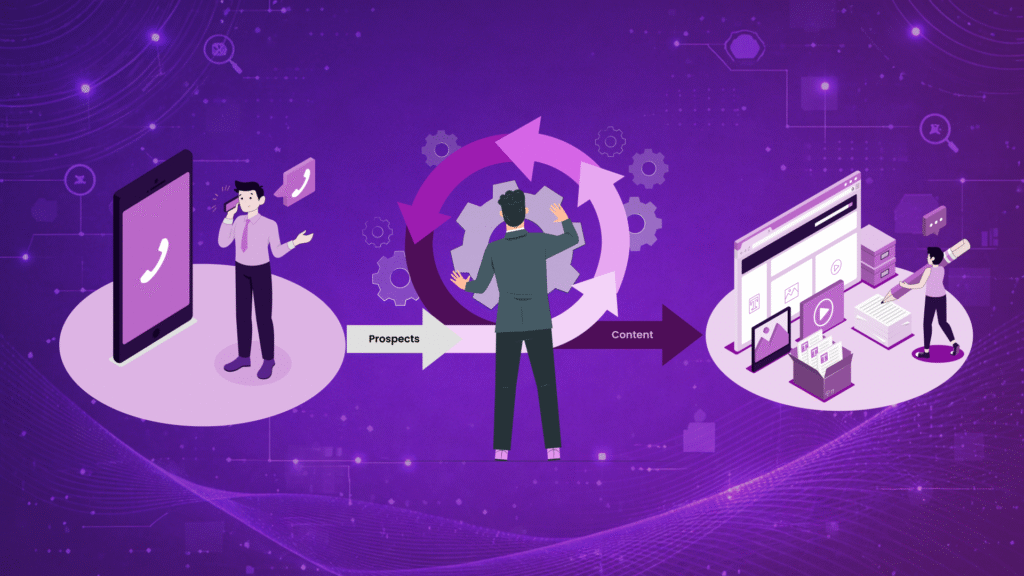
This is the most underused advantage in cybersecurity SEO because it’s not an “SEO trick.” It’s more about being smart with your resources and using them well.
Your discovery calls contain questions that would concern many of your prospects equally. Those questions are not random. They map to commercial-intent search queries that buyers will Google when they don’t want to ask you directly. That makes them perfect for SEO.
Typical examples include “SOC 2 timeline for startups,” “ISO 27001 scope definition,” “HIPAA compliance cost,” “difference between VAPT and pentesting,” “how to prioritize pentest findings,” and “what evidence auditors expect.”
This makes your sales call repository, a “content gold-mine”.
Because it aligns perfectly with buyer preference data and their concerns.
Gartner’s research (cited earlier) shows many buyers prefer self-service research and avoid irrelevant outreach. When you publish content that answers their “silent questions,” you become the vendor that feels low-friction and credible.
7) Help buyers go through all sales stages
Most cybersecurity sites would be better just as brochures. They mention services, but never go beyond a certain level of detail to explain their visitors.
They have awareness blogs and a generic “contact us” page, then they wonder why traffic doesn’t convert.
In 2026, SEO for cybersecurity must support the whole journey because buyers move through stages with different information needs.
Gartner describes the modern B2B journey as non-linear, where buyers move between distinct buying jobs and often revisit them. That means your content architecture should not be a straight funnel. It should be a set of guided paths.
Awareness content should focus on symptoms, risks, and “what this means operationally.”
Evaluation content should focus on methods, approaches, tool vs service decisions, and internal effort. Decision content should focus on what it takes to implement, timelines, pricing drivers, scope definition, and vendor selection criteria.
The nuance here is that every stage should have its own conversion mechanism.
Awareness content should not push “book a call” as the only CTA.
It should offer a checklist, a self-assessment, or a framework download.
Evaluation-stage content can offer a comparison guide or a scoping worksheet. Decision-stage content can offer a consultation, a paid assessment, or a readiness workshop.
Build your pages and content so that they cater to all the concerns your prospects might have, and that will help you shorten your sales process as well.
8) Connect other social media to the website
In 2026, SEO isn’t just about the website. We’re not living the true meaning of “search engine optimization” Since Google now takes answers from major social media platforms, the real deal is to integrate them all, creatively and tightly.
The mistake most cybersecurity teams make is treating social as a “separate channel” with its own content, while the website content and blogs live in isolation.
Now, the winning model looks more like an ecosystem: your website is the credibility and conversion engine, and social is the distribution engine that keeps feeding it.
This matters even more in an AI-heavy search era where clicks can come even on informational queries.
If AI summaries reduce direct traffic on certain keywords, your brand still needs a way to generate return visits and branded search. Social does that.
The strategy is simple but requires discipline. Every long-form blog should be “decomposed” into a multi-post sequence: a contrarian insight, a framework snippet, a common mistake post, a checklist, and a short case-style story.
Each post could ideally link back to one core page. Connect your social media profiles very strictly with your website. Gradually, with consistency, you’ll see the traffic flow from your social media profiles to your website and vice-versa.
This connectivity and topic clusters across social media also helps your brand get recognized well with AI engines.
A useful stat to reinforce why ranking position still matters for clicks: Backlinko’s CTR study reports that the #1 result gets a materially higher CTR than lower positions.
In an environment where clicks are under pressure, you want to win the top slots on the queries that still drive high-intent traffic. Social distribution helps you earn the behavioural momentum and brand searches that support that.
9) Technical SEO hygiene and page speed
This is the strategy everyone agrees with but is not executed consistently.
In 2026, content quality is table stakes. Technical quality decides whether your content gets crawled efficiently, rendered correctly, and experienced smoothly. If your site is slow, clunky, and bloated, you lose both rankings and conversions.
Google has made the importance of responsiveness explicit. Interaction to Next Paint (INP) officially replaced First Input Delay (FID) as a Core Web Vital on March 12, 2024. That matters because cybersecurity sites often load heavy scripts, chat widgets, cookie banners, and tracking tools. These can wreck INP, especially on mobile.
Technical hygiene in cybersecurity SEO should include:
- Core Web Vitals monitoring,
- Image optimization
- Script cleanup
- Index bloat reduction
- Canonical discipline
- Schema implementation,
- Internal link depth control
- Consistent redirects
It should also include security-conscious web practices because nothing kills trust faster than a security company with a poorly configured website.
10) Simplistic design for better navigation and page structure
Cybersecurity websites love complexity. Big menus. Too many “solutions.” Fancy animations. Three click paths to reach a service page. A service page which is linked on content but not on the navigation menu or just a use-case which leads to nowhere.
That hurts SEO and conversion.
Google’s people-first framing is not just about content. It’s about helping users accomplish their goals. If your design makes it hard to find the right page, you create friction. Friction increases bounce and reduces conversion signals.
The nuance here is information architecture.
Your navigation should reflect how buyers search and decide.
Most cybersecurity buyers think in terms of outcomes and categories like compliance, pentesting, managed security, cloud, application security, and incident response.
They don’t think in your internal org structure. If you align navigation to buyer mental models, users find what they need faster and makes communication with them smoother.
A final layer that ties all 10 strategies together
If you want this to feel like a 2026-grade playbook, you need one overarching theme that connects everything:
Cybersecurity SEO is more about a strong architecture than just content writing.
AI-driven search makes structure mandatory. Buyer behavior makes self-serve journeys mandatory. Selling cybersecurity makes credibility mandatory. Google’s documentation makes people-first helpfulness mandatory.
When you get this architecture right, you can establish domain authority easier.
When you structure content for AI extraction, you protect meaning and visibility. When you go deep technically, you attract serious buyers. When you write long-form with completeness, you reduce pogo-sticking and increase conversion paths. When you use brand-aligned graphics, you reduce cognitive load and improve distribution.
When you turn discovery calls into content, you publish what buyers actually need. When you cover every buying stage, you convert intent into pipeline. When you connect social to the site, you build demand loops. When you maintain technical hygiene, you keep rankings and UX stable. When you simplify design, you reduce friction and increase conversions.
That is the 2026 model.
Let’s execute SEO for your cybersecurity brand and expand your brand’s discovery potential.